Practical
Monument Valley Weather: Month by Month and the Best Time to Visit
Monument Valley weather is high-desert weather: hot, dry summer days that cool quickly after dark, a burst of afternoon thunderstorms in July and August, a long, settled autumn, and cold winters with the occasional light snow. The valley sits higher than most people expect. The Navajo Nation’s own park page puts Monument Valley Navajo Tribal Park at 5,564 feet above sea level, and that altitude does a lot of the work, taking the edge off the summer heat and making winter nights properly cold.
The best long-run numbers come from a weather station inside the valley itself. The Western Regional Climate Center keeps a monthly summary for the Monument Valley Mission station, on the Utah side of the valley, with records from August 1, 1961 to December 31, 1989. Those figures are older than a modern 30-year normal, but they were measured on the valley floor rather than in a town a hundred miles away, and they match what Visit Utah and the National Weather Service say today. This article walks through them month by month, then covers the summer monsoon, snow, the park’s seasonal hours, and the best time to go for what you want to see.
Monument Valley weather at a glance
- Hottest month: July, with an average high of 92.3 °F and an average low of 67.3 °F at the valley station.
- Coldest months: December and January. January averages a high of 41.2 °F and a low of 23.8 °F.
- Wettest months: July and August, at 0.97 inches each, with October close behind at 0.95 inches.
- Driest month: June, at 0.25 inches.
- Snow: 13.2 inches a year on average, almost all of it from November to March, and it rarely lasts on the ground.
- Storm season: the National Weather Service gives the northern Arizona monsoon as June 15 to September 30; storms usually arrive in the first week of July.
- Most popular seasons: spring and autumn, according to Visit Utah.
- Clock warning: the Navajo Nation observes daylight saving time, so in spring and summer the park runs an hour ahead of Page and Flagstaff.
Why the valley is a high desert
Monument Valley is part of the Colorado Plateau. The floor of the valley lies between 5,000 and 6,000 feet above sea level, and the sandstone formations rise 400 to 1,000 feet above that. There is little water and little shade, and the air is thin and dry, so the sun heats the ground fast during the day and the heat drains away fast at night.
The result is a big daily swing. At the valley station the average gap between the afternoon high and the overnight low is around 20 to 25 °F in most months. In July that means a high of 92.3 °F and a low of 67.3 °F; in October, 69.2 °F and 46.4 °F.
Annual rainfall is low: 7.40 inches a year at the station, spread unevenly. Most of it falls in short, heavy storms in late summer and in autumn, and the rest as light winter rain and snow. The annual average high is 67.1 °F and the annual average low 45.2 °F.
Month-by-month climate table
These are the Western Regional Climate Center averages for the Monument Valley Mission station, 1961 to 1989, in degrees Fahrenheit and inches.
| Month | Avg high (°F) | Avg low (°F) | Precipitation (in) | Snowfall (in) |
|---|---|---|---|---|
| January | 41.2 | 23.8 | 0.39 | 3.6 |
| February | 48.0 | 28.5 | 0.52 | 2.5 |
| March | 57.1 | 35.4 | 0.53 | 1.5 |
| April | 66.0 | 42.2 | 0.41 | 0.4 |
| May | 76.4 | 52.6 | 0.47 | 0.1 |
| June | 86.9 | 61.4 | 0.25 | 0.0 |
| July | 92.3 | 67.3 | 0.97 | 0.0 |
| August | 89.7 | 65.8 | 0.97 | 0.0 |
| September | 81.5 | 58.2 | 0.76 | 0.0 |
| October | 69.2 | 46.4 | 0.95 | 0.1 |
| November | 53.9 | 34.8 | 0.59 | 0.7 |
| December | 42.7 | 26.3 | 0.60 | 4.2 |
Visit Utah’s own winter page gives rounded figures that agree closely: average highs and lows of 69/46 °F in October, 53/34 °F in November, 42/25 °F in December and January, and 48/29 °F in February.
Spring: March to May
Spring is when the valley warms up fast. The average high climbs from 57.1 °F in March to 66.0 °F in April and 76.4 °F in May, while nights go from below freezing in early March to the low 50s by late May. March can still bring snow, and the station records 1.5 inches in an average March.
It is also a dry season. April and May average well under half an inch of rain each, and the big summer storms are still months away. Visit Utah notes that most visitors come in spring and autumn to enjoy the high-desert environment, so expect company at the visitor center and on the Valley Drive.
The park’s backcountry guidance warns that the weather here is often extreme and can change quickly. On an open-air tour, sunglasses and something to cover your mouth against blowing sand are worth packing.
Summer: June to August
Summer is hot but not as hot as the low deserts. Visit Utah says the searing heat usually begins in late May and can last into mid-September, with temperatures that may reach the mid-90s °F in July and August. The valley station puts the average July high at 92.3 °F, and the valley averages 54 days a year above 90 °F, yet summer highs rarely go past 100 °F, because of the altitude.
June is the dry, bright month. It averages only 0.25 inches of rain, and the National Weather Service in Flagstaff notes that northern Arizona normally sees some of its hottest and driest weather of the year in June, before the monsoon moisture arrives. There is very little shade on the Valley Drive or the Wildcat Trail.
July and August change the pattern: hot mornings, clouds building by early afternoon, and a good chance of a thunderstorm before sunset. Nights stay mild, in the mid-60s °F.
Practical points for summer:
- Water: the park’s own page asks visitors to stay hydrated; carry more than you think you need, even for the drive.
- Timing: the coolest, calmest light is at sunrise and in the last hours before sunset.
- Trails: the park warns that in summer the trails are hot and dry. The Wildcat Trail, the one hiking trail open without a guide, is 1.5 miles by the park’s count (Visit Utah describes it as a 3.2-mile loop, 4 miles in all including the return to the trailhead); start early.
The monsoon: July to September
The Southwest monsoon is not a single storm but a seasonal shift in the winds that carries moisture north from the Gulf of California and the eastern Pacific. The National Weather Service in Flagstaff gives the season as June 15 to September 30, but adds that in northern Arizona the moisture typically does not arrive until the first week of July.
What it means on the ground:
- Afternoon storms: rain is not continuous; it comes most days as afternoon and evening thunderstorms.
- A big share of the year’s rain: much of northern Arizona gets 40 to 50 percent of its annual precipitation in the monsoon. At the valley station, July and August each average 0.97 inches, close to double most other months.
- Lightning: fire starts from dry lightning are common early in the season, before the rain catches up.
- Flash floods: the Navajo Parks and Recreation Department says the danger of flash floods is greatest during the summer monsoon, July through September, though they can happen at any time of year.
For a visitor the monsoon has two sides. The storms bring the most dramatic skies of the year, with dark clouds behind the Mittens and shafts of light on the buttes, and photographers often time their trips for them. But the Valley Drive is a natural dirt road with deep sand, and the park warns that roads on the Navajo Nation can become impassable in wet weather and that conditions change quickly. If a storm is building, stay out of washes, avoid exposed high points, and wait it out in the vehicle.
Autumn: September to November
Visit Utah calls autumn some of the most stable weather of the year: clear, warm, sunny days and cool nights. The station numbers show why. September averages a high of 81.5 °F and a low of 58.2 °F; October, 69.2 °F and 46.4 °F; November, 53.9 °F and 34.8 °F.
The catch is October rain. The station records 0.95 inches in an average October, almost as much as July or August, usually from the occasional large storm system rather than daily thunderstorms. In most years October is still dry, bright and comfortable, but it pays to watch the forecast.
Autumn is also the season of shortening park hours. The park’s 2026 schedule shows the change clearly:
- September 29 to October 2: visitor center viewpoint and patio 6:00 a.m. to 8:00 p.m.; scenic drive 8:00 a.m. to 6:00 p.m., last entry at 3:30 p.m.
- October 3 to 16, 2026: viewpoint and patio 7:00 a.m. to 7:00 p.m.; scenic drive unchanged.
- From October 17 (winter hours): viewpoint and patio 8:00 a.m. to 5:00 p.m.; scenic drive 8:00 a.m. to 5:00 p.m., last entry at 2:30 p.m.
Check the park’s page before you go, as these are set season by season.
Winter: December to February
Winter is cold, bright and quiet. Visit Utah says December and January bring the coldest weather, and the station agrees: January averages a high of 41.2 °F and a low of 23.8 °F, and December 42.7 °F and 26.3 °F. Visit Utah sums it up as cold and windy, with some nice days and average highs in the 40s.
Nights are well below freezing, so anyone out for sunrise needs proper winter clothes. Visit Utah’s packing list for a winter trip is a warm hat, gloves, an insulated coat, waterproof boots or trail shoes, and traction cleats. The park’s backcountry guidance adds that in winter the elevation brings severe cold and high winds.
The reward is space. Visit Utah gives two reasons for a winter visit: no crowds and no heat. The light is low and warm all day, the shadows are long, and on a clear morning the air is very sharp.
The park closes on Thanksgiving Day (November 26), Christmas Day (December 25) and New Year’s Day (January 1), so plan around those dates.
Snow in Monument Valley
Snow is real but light. The station averages 13.2 inches of snowfall a year: 4.2 inches in December, 3.6 in January, 2.5 in February, 1.5 in March, and small amounts in April, May, October and November. The average snow depth at the station is 0 inches in every month, because it melts so fast.
Visit Utah says snow can fall any time between November and March but is typically light enough to melt in a day or two, without impeding traffic on the 17-mile loop. It also notes that a dusting of snow on the red rock is considered a photographic fortune. If you are lucky enough to wake up to snow on the buttes, go out early: by midday it may be gone.
Sunrise, sunset and the valley’s clock
The light is the reason many people come, and it depends on the season. In summer the sun rises early and sets late, and the park opens its viewpoint early: in late September 2026 the visitor center viewpoint and patio opened at 6:00 a.m., and from May 1 to September 30 the park lists hours of 6:00 a.m. to 8:00 p.m. In winter the viewpoint opens at 8:00 a.m., later than sunrise, so a winter sunrise is best seen from outside the park, or on a guided tour that includes it.
The bigger trap is the clock. Most of Arizona stays on standard time all year, but the Navajo Nation observes daylight saving time, from March to November. The Navajo Tourism Department spells it out: in spring and summer, when it is 2 p.m. in Flagstaff, it is 3 p.m. in Monument Valley. Tour operators work on Navajo Nation time, which during daylight saving time is one hour ahead of the Arizona time used in Page or Flagstaff. If you are driving in from Page for a sunrise or sunset tour, set your phone to the right zone, or you may arrive an hour late.
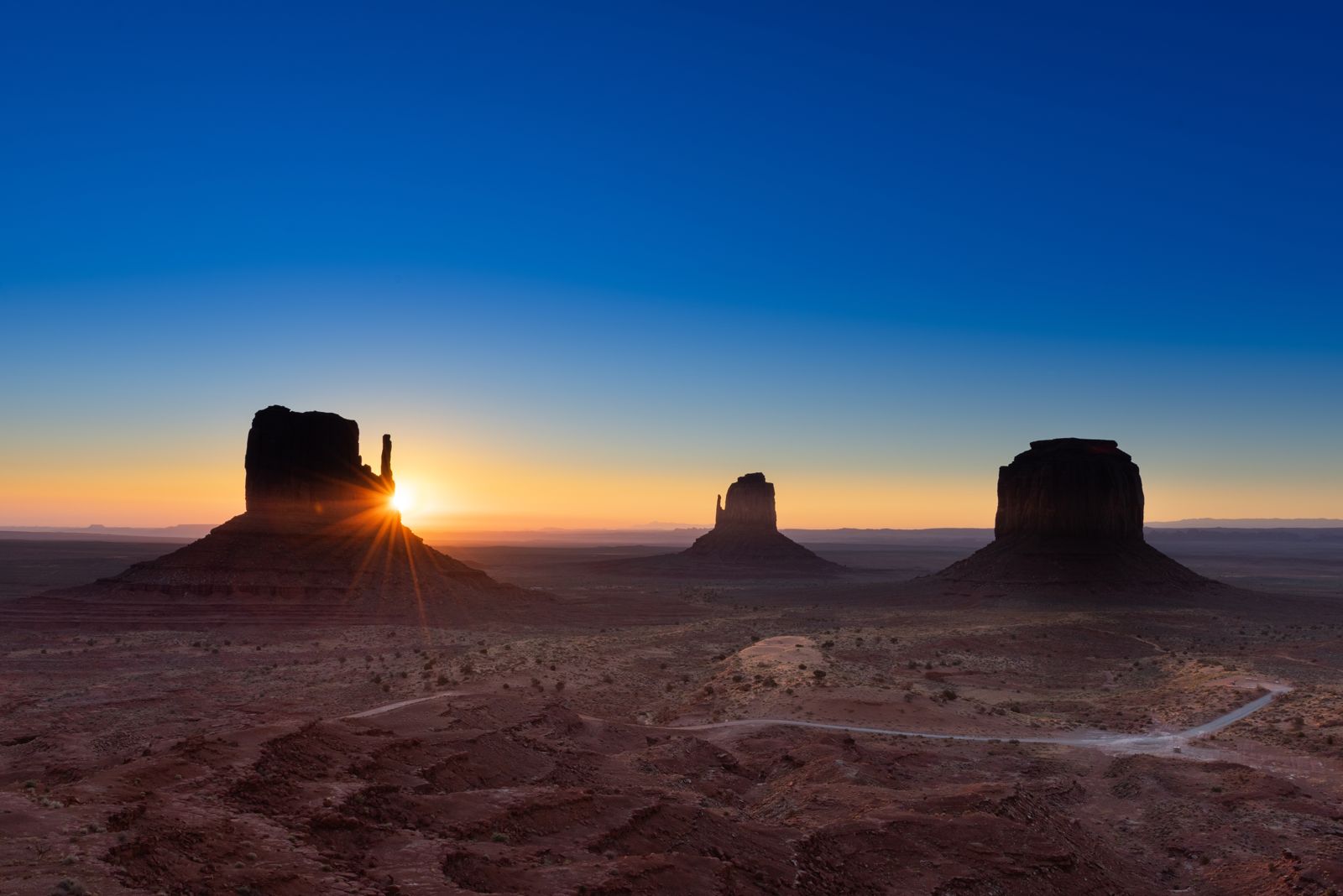
Visit Utah’s advice for the classic roadside view at Forrest Gump Point applies across the valley: the sunrise lights the formations from the front, and at sunset the sun drops behind them. Our article on Monument Valley in the movies covers that viewpoint.
How weather affects the Valley Drive and tours
The 17-mile Valley Drive is the main way to see the formations on your own, and it is a dirt road. The park describes it as all natural, with very rough terrain and deep sand dunes, and says an SUV or truck is preferable; it does not allow motorcycles. Visit Utah says to allow about three hours to drive it.
Weather changes that picture:
- After rain: wet sand and clay can make the road hard going, and the park warns that roads can become impassable in wet weather.
- Wind: blowing sand reduces visibility and gets into cameras; open-air tour vehicles get the full effect.
- Winter: light snow usually melts within a day or two, but the shorter winter hours, with last entry to the scenic drive at 2:30 p.m., matter more than the snow.
- Peak season: the park asks visitors to be ready for long waits and inclement weather in the peak season.
Guided tours with Navajo operators go beyond the loop to places such as Ear of the Wind, which the park says can only be reached on a guided tour. In hot or stormy weather, a guide who knows the valley and its roads is a real advantage. Our tours page lists the sunrise, sunset and backcountry options.
The best time to visit Monument Valley
There is no bad season, only different trade-offs.
- For comfortable days and settled weather: late September and October. Average highs fall from 81.5 °F in September to 69.2 °F in October, nights are cool, and what Visit Utah calls some of the most stable weather of the year. Watch for the switch to winter hours from October 17.
- For spring warmth: April and May, with highs from 66.0 °F to 76.4 °F, little rain and longer days.
- For dramatic skies: July and August, when monsoon storms build in the afternoon. Expect heat, possible road problems after rain, and the need to plan around lightning.
- For solitude and snow: December to February. Cold mornings and short hours, but no crowds and the chance of red rock dusted white.
- For long summer evenings: June, the driest month, with clear skies, but little shade and the hottest, driest weather of the year before the storms.
Whatever the month, plan your day around the low sun. Sunrise and the last hours before sunset are when the buttes glow, and in summer they are also the most comfortable times to be outside.
What to pack by season
- Spring and autumn: layers for a 20-degree swing, a warm jacket for early starts, sun hat, sunglasses, and a scarf or buff against blowing sand.
- Summer: plenty of water, sun protection, light long sleeves, and a rain shell for July and August storms.
- Winter: a warm hat, gloves, an insulated coat, waterproof boots and traction cleats, as Visit Utah suggests, plus a thermos for sunrise.
- All year: a full tank of fuel, snacks, and offline maps. Remember that drones are prohibited on the Navajo Nation, and that the park asks visitors to stay on the designated route.
Frequently asked questions
What is the weather like in Monument Valley?
High desert. At the valley’s climate station, average highs run from 41.2 °F in January to 92.3 °F in July, and lows from 23.8 °F to 67.3 °F. It gets only 7.40 inches of precipitation a year, most of it in late-summer thunderstorms and autumn storms.
When is the monsoon in Monument Valley?
The National Weather Service gives the northern Arizona monsoon season as June 15 to September 30, with moisture usually arriving in the first week of July. July and August are the stormiest months, with afternoon and evening thunderstorms and a risk of flash floods.
Does it snow in Monument Valley?
Yes, lightly. The station averages 13.2 inches of snow a year, mostly from November to March, and Visit Utah says it usually melts in a day or two without closing the loop road.
What time zone is Monument Valley in?
The Navajo Nation follows daylight saving time from March to November, while most of Arizona does not. In spring and summer, Monument Valley is one hour ahead of Page and Flagstaff.
What is the best month to visit Monument Valley?
For settled weather, late September and October; for warm, dry days, April and May; for storm skies, July and August; for empty viewpoints and a chance of snow, December to February.